Mobile Detailing LLC, Taxes & Write-Offs (2026 Guide)

The Short Answer
Form an LLC ($50–$300) from day one — costs almost nothing and unlocks a business bank account, EIN, and liability separation. File taxes as a sole prop (Schedule C) until your net profit crosses ~$40K, then elect S-corp status to save $4K–$10K/year in self-employment tax. Pay quarterly estimates by 4/15, 6/15, 9/15, 1/15. This is general education, not tax advice — consult a CPA for your specific situation.
Want the full system? The Mobile Detailing Academy course covers pricing, equipment, and client acquisition step by step — $39, lifetime access.
Nobody pays their way out of business by overpaying taxes. A well-run mobile detailer with $75K net profit legally pays $4K–$10K less in tax than a poorly-run one. It's all in the entity choice, the deductions, and one election most operators miss.
Legally no, practically yes. An LLC separates business liability from personal assets, unlocks a business bank account (required by most fleet clients), and costs $50–$300 to file. Filing it late is one of the most common regrets we hear from year-two operators.
Step 1 — LLC in 90 Minutes
- File Articles of Organization with your state's Secretary of State ($50–$300 depending on state)
- Apply for an EIN at irs.gov/ein (free, takes 5 minutes, don't pay a service)
- Open a business checking account (Chase, Bluevine, Relay, Novo all work)
- File your state's beneficial-ownership report if applicable (2024+ requirement)
- Register for sales tax if your state taxes detailing services (varies — CA, TX generally no; NY, WA, HI yes)
Step 2 — LLC Tax Treatment
An LLC by default is 'pass-through' — you file business income on your personal 1040 via Schedule C. You pay: (a) federal income tax at your bracket + (b) self-employment tax at 15.3% on the first $168,600 of net profit. That 15.3% is the pain point most detailers underestimate in year one.
Step 3 — When (and Why) to Elect S-Corp
Once your NET PROFIT (revenue − expenses) reliably crosses ~$40K/year, elect S-corp status via IRS Form 2553. You then pay yourself a 'reasonable salary' via payroll — that portion pays SE tax. The remaining profit distributes to you as an owner draw with NO SE tax. Typical savings on $75K net: $5K–$8K/year.
The S-Corp Trade-Off
S-corp status adds ~$1,500/year in payroll processing + CPA cost. It only makes sense once savings exceed that overhead. Under $40K net profit → stay sole prop. Over $50K net profit → elect S-corp. Between $40K–$50K → talk to a CPA about your specific state.
The Deduction Playbook for Detailers
| Category | What Counts | Notes |
|---|---|---|
| Vehicle expense (mileage OR actual) | Every mile driven for business — job sites, supply runs, bank trips | IRS standard mileage rate 2026: 70¢/mile (est.). Track with MileIQ / TripLog |
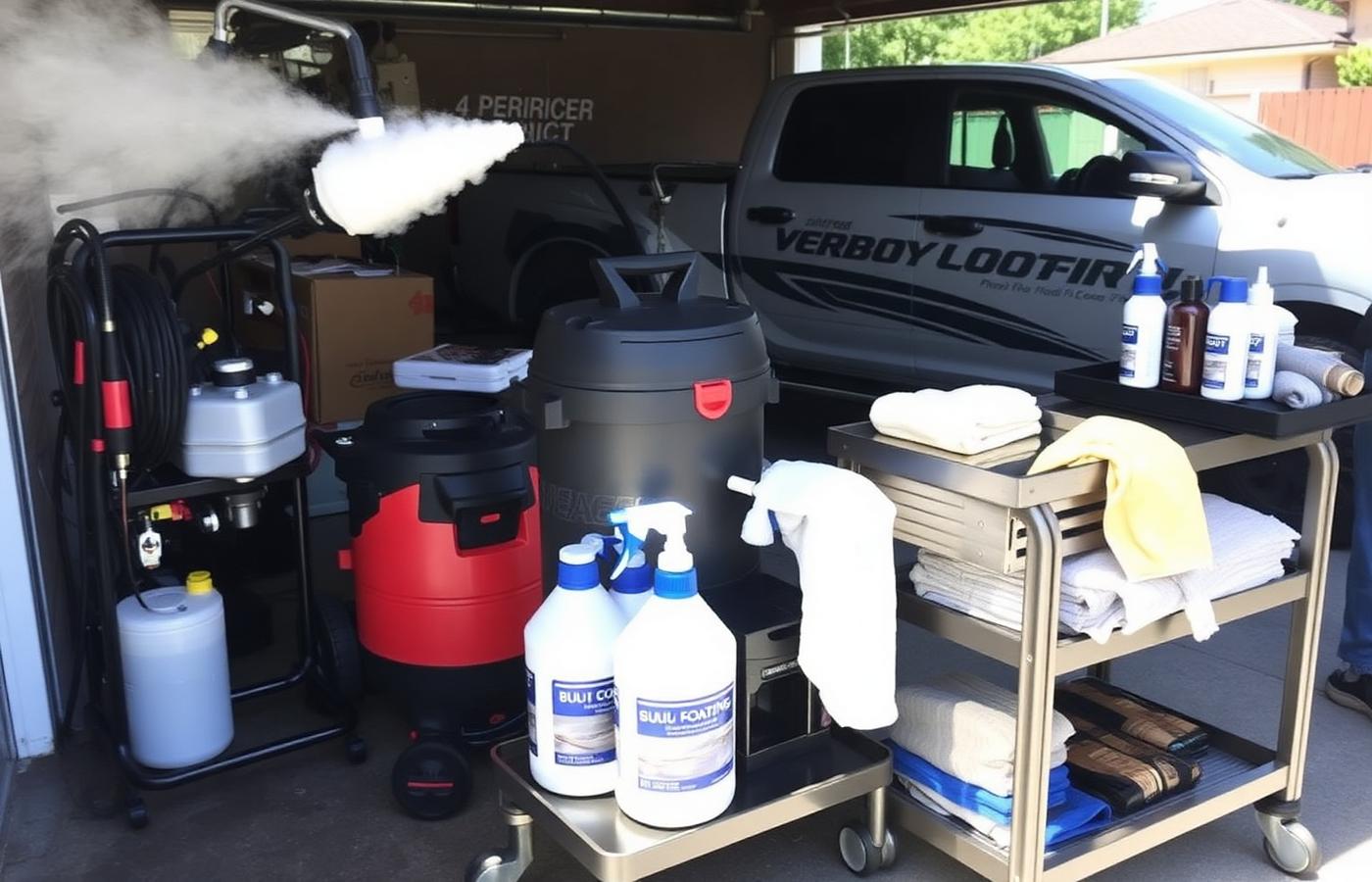
| Chemicals & consumables | Soap, wax, sealants, ceramic coatings, microfibers, pads | 100% deductible in year of purchase |
| Equipment | Pressure washer, extractor, polisher, tank, generator | Section 179 or bonus depreciation — often fully deductible year one |
| Insurance premiums | GL, garage keepers, inland marine, commercial auto | 100% deductible |
| Home office | Portion of home used exclusively + regularly for business | Simplified method: $5/sq ft up to 300 sq ft = $1,500 max |
| Phone & internet | Business-use portion of your cell + home internet | Track % use; typically 50–70% for a full-time detailer |
| Marketing | Website, GBP boosts, business cards, flyers, decals, ad spend | 100% deductible |
| Continuing education | Detailing courses, training, industry conferences | 100% deductible — yes, this course qualifies |
| Uniforms & PPE | Branded shirts, respirator, gloves, non-slip shoes | Deductible if not suitable for everyday wear |
| Meals (client / fleet) | Meeting with a fleet manager, dealership contact | 50% deductible |
| Bank & processing fees | Stripe, Square, business banking fees | 100% deductible |
Mileage vs Actual — Which One Wins
Standard mileage (70¢/mile est. for 2026) usually wins for a solo detailer using a personal vehicle for business. Actual method (gas + insurance + maintenance + depreciation × business-use %) wins for large SUVs, cargo vans over 6,000 lbs GVWR, or heavily-modified rigs. You must pick one method the first year and can only switch under specific rules — talk to a CPA before the first quarterly.
Quarterly Estimated Tax Schedule
| Quarter | Due Date | What to Pay |
|---|---|---|
| Q1 (Jan–Mar income) | April 15 | 25% of expected annual tax OR 25% of prior year × 110% |
| Q2 (Apr–May income) | June 15 | Same math on YTD income |
| Q3 (Jun–Aug income) | September 15 | Same math |
| Q4 (Sep–Dec income) | January 15 | True-up to actual YTD |
Safe Harbor Rule
Pay quarterly estimates equal to 100% of last year's total tax (110% if AGI > $150K) and you avoid IRS underpayment penalties regardless of what you actually earn this year. It's the safest baseline for a growing detailing business — you can always over-pay quarterly and get the refund.
Bookkeeping Setup (2 Hours, Then 30 Min/Week)
- Business bank account — every business expense goes through it, no personal card use
- QuickBooks Online Simple Start ($30/mo) or Wave (free) for categorization
- Sync bank feed weekly, categorize expenses in 20-min sessions
- Save receipts via phone photo → auto-attach to transactions in QBO
- End of month: reconcile bank, review P&L, set aside estimated tax to a separate savings account (30% of net is a safe rule)
The Three Most Common Mistakes
- Mixing personal and business spend on one card — this ALONE can 'pierce the corporate veil' and eliminate LLC liability protection
- Not paying quarterly estimates → owing $8K–$15K in April + late-payment penalty
- Deducting a personal vehicle at 100% business use when it's obviously your daily driver too (an audit red flag)
Frequently Asked Questions
Sole prop, LLC, or S-corp?
Start as an LLC taxed as sole prop (default). Elect S-corp status once net profit reliably exceeds $40K. Skip C-corp entirely — double taxation destroys the benefit for a service business.
What state should I form my LLC in?
Your home state — where you actually operate. Delaware / Wyoming LLCs sound clever online but require you to register as a 'foreign LLC' in your home state anyway, doubling the fees. Wyoming only makes sense for pure holding companies.
Do I need a CPA?
For sole-prop years, no — TurboTax Self-Employed handles Schedule C fine. Once you elect S-corp, yes — payroll + Form 1120-S filing is worth the $800–$1,500/year fee to avoid mistakes.
Is this legal / tax advice?
No. This is a general framework, not advice. Your state, your income, your assets, and your family situation all change the math. Consult a CPA and a lawyer before you make any of these decisions.
Related Guides
Mobile Detailing Academy
A team of full-time mobile auto detailers, ceramic coating installers, and small-business coaches. The Academy has trained thousands of new detailers to launch profitable mobile operations from their driveway.